How it works · The tutor
What the tutor does, and does not do
A conversation that moves a student forward. Not a chatbot that says “well done”, and not a machine that takes over the work.
This is what it sounds like.
The tutor helps every student at their own level, until it is really understood. It does not give answers away: it looks for where things get stuck and works on exactly that. In every subject, at every level.
Example of a tutor conversation in GoYou, class 3rd year vmbo-t, lesson Percentages at the hair salon. Tutor: A jacket costs €80, with 25% off. What do you pay? Student: 55 Tutor: I think you did 80 minus 25. But how many euros is 25% of 80, really? Student: oh yeah 20 Tutor: Exactly. And then? Student: so 60 Tutor: Yes. See what just happened? Percentages aren’t euros. Shall we do another one?
Four conversations from different subjects and levels, one after the other (vmbo and havo are Dutch secondary school tracks, MBO is vocational education). Example of a tutor conversation, not a screenshot.
It feels like a conversation. It is practice on the lesson.
Every student works on the same steps, with the same goal and the same bar. What differs is the route there: one gets a hint, another a counter-question, a third a smaller piece. If a student gives a wrong answer, they get an extra question that puts them back on the right track. If a student stays stuck, even after a hint and a smaller question, it is passed on to you, with what still needs attention. Along the way, the tutor makes sure that nobody skips the material and that nobody stays stuck. By the end of the lesson your whole class has worked through the same material, even though each of them had their own conversation.
The tutor also knows what happened in your lesson. It refers back to the presentation, which the student can open to look back through, and it carries the same design as your lesson. With each student it picks up where they left off last time: what has already stuck does not need repeating, and what still needed attention, it comes back to.
What the tutor does not do.
It does not take over the work
The tutor guides, it does not fill in. A student who tries to prise the answer out of it gets a question back.
It does not wander off
What the tutor discusses is tightly framed: it stays within the material and the lesson you set.
It does not make things up
If the tutor does not know an answer, or the question falls outside its limits, it says so honestly to the student and passes the question on to you, the teacher.
It does not make decisions about your class
Signals, questions and answers always go through you. The tutor prepares, you decide what happens.
Power to the teacher
Students’ questions end up with you, not with a machine.
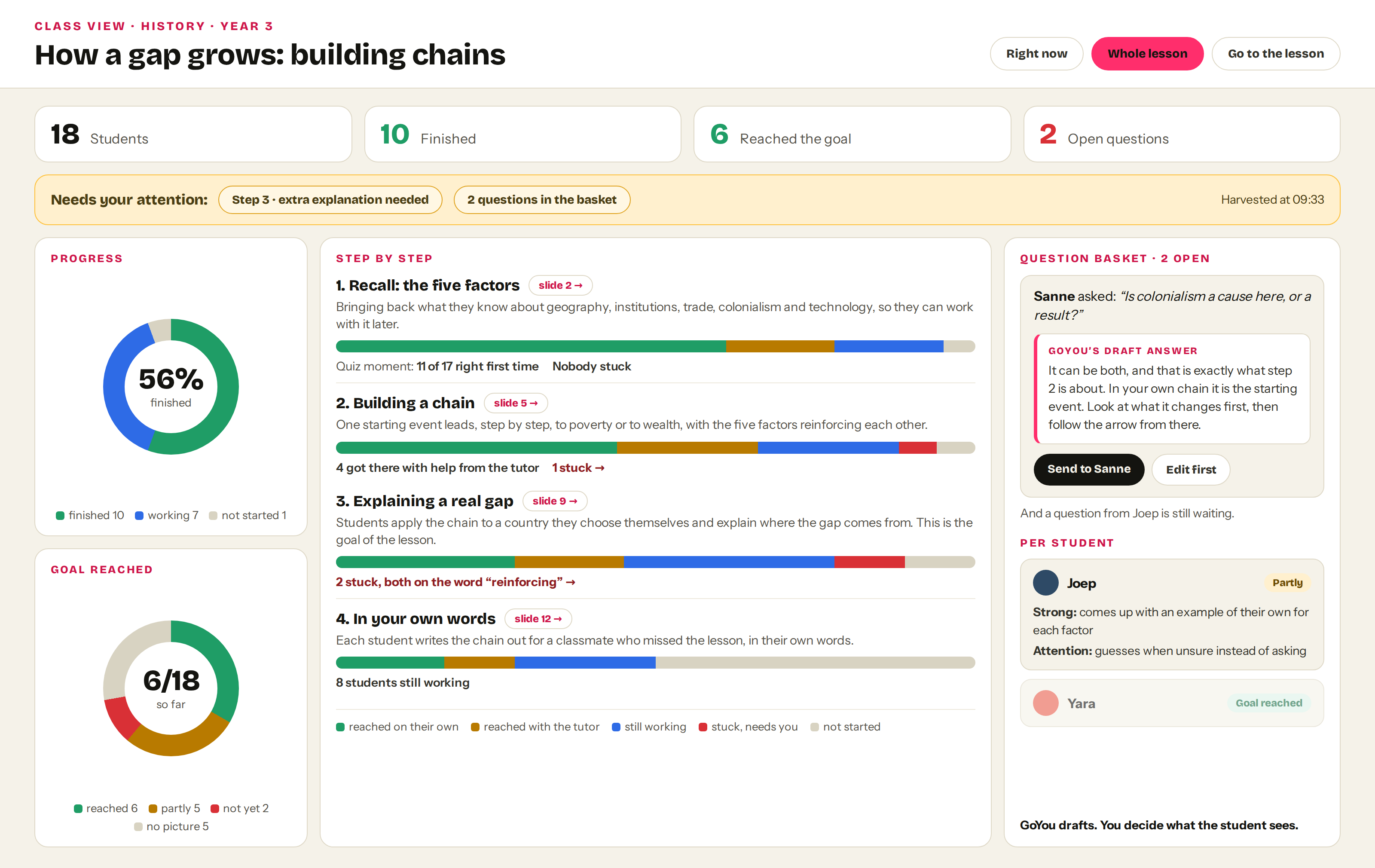
If a student asks something the tutor is not there for, it parks the question and says so honestly. You get to see the question or comment, with a draft answer you can edit, throw away or send. Only when you click send does it go to the student. If more students have the same question, you automatically get a suggestion to cover it in the next lesson.
You keep an eye on it.
While your class is working, you see who is where, who is stuck and which questions are on their minds, without a pile of marking: GoYou marks the work. For each student, GoYou draws one strong point and one point for attention from the conversation with the tutor, so in a few seconds you know what to say to whom. If several students get stuck on the same step, GoYou suggests extra explanation, and for students’ questions you get a draft answer. You decide what happens with it. What happens to student data and where it is stored, you can read under Safety and privacy.
Any other questions about the tutor?
Ask the GoYou Helpdesk: what the tutor does and does not do, how strict it is, and what happens to the conversations.